
What a School Nurse Log Should Record, and Why
A visit note written at the end of the day records that something happened. One written at the time records what was known when the decision was made — different documents when a parent asks why.
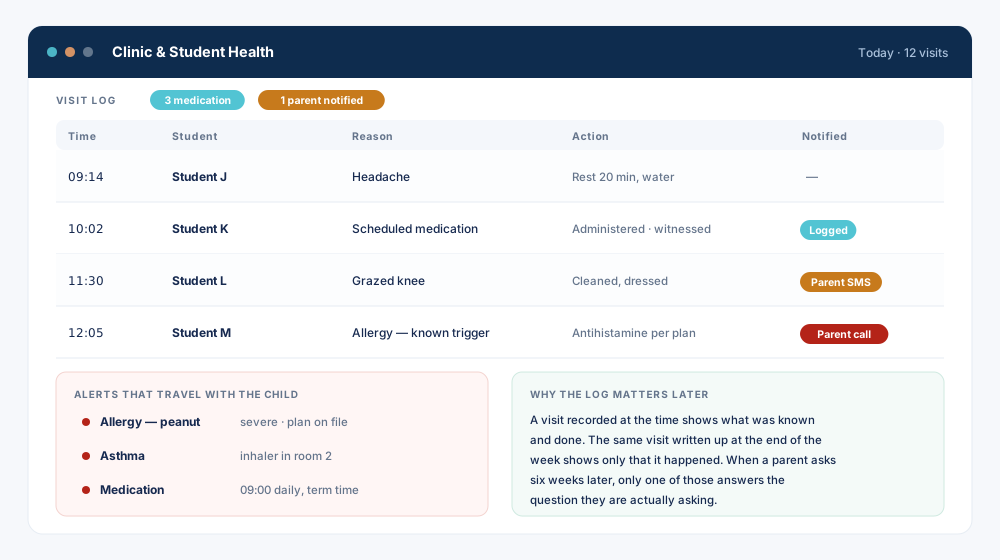
A school clinic is a place where small things happen constantly and one thing occasionally matters enormously. The record has to serve both: fast enough that a grazed knee does not generate paperwork, complete enough that an allergy incident six weeks ago can be reconstructed exactly.
Most settings solve the first and assume the second. It is the second that gets tested.
The log is not a diary
A visit note written at the end of the day is a diary entry. It records that something happened. A visit note written at the time records what was known when the decision was made — and those are different documents when a parent asks why a particular call was taken.
The distinction costs almost nothing to maintain if the log is quick to write. It becomes impossible to recover afterwards, which is why the design constraint on a clinic log is speed rather than completeness.
What each visit should carry
- Time — not the date. A pattern of Monday-morning stomach aches is a pastoral signal, and it is invisible without timestamps.
- Reason as presented — what the child said, not only what the nurse concluded.
- Action taken — including “rested and returned to class”, which is a decision like any other.
- Notification — whether a parent was told, by what route, and when.
Medication is the part that must be airtight
Administering medication in a school is the highest-consequence routine act in the building. A defensible record holds four things together: the drug and dose, the time, the person who administered it, and the written authorisation it was given under.
The authorisation is the field most often missing, because it lives in a form filed somewhere else. Holding it on the child record rather than in a folder is what turns “we have consent” from a belief into something demonstrable.
Alerts have to travel
The most dangerous version of a medical record is one that is complete and stationary. A severe allergy documented in the clinic is not protection if the cover teacher on a trip does not know about it.
Alerts that matter for safety should surface wherever the child appears — the register, the trip list, the cover teacher’s view — while the detailed history stays restricted. That split is the whole design. Our clinic module holds the record once and surfaces the alert where duty of care applies, rather than copying the information into places where it then goes stale.
Why copies are the failure mode
Every school has a laminated allergy list somewhere. It was accurate on the day it was printed. The moment a parent updates something, there are two versions and only one of them is right — and the wrong one is on the wall in the room where the decision gets made.
Under UAE PDPL this is also a governance question: holding health data lawfully means being able to say where it is held and who can see it. A record with an unknown number of printed copies cannot answer either half.
The test
- If a parent asks about a visit from last term, how long does the answer take?
- When an allergy changes, how many places need updating?
- Can you show the authorisation for every medication given this month?
Related reading: the paperwork year covers where the consents and authorisations behind these answers should live.
Frequently asked questions
How much detail belongs in a visit note?
Enough that someone who was not there can tell what was observed, what was done and what was decided. Clinical judgement does not need to be justified in the note, but the action taken and the reason for it should be legible six months later to a colleague or a parent.
Should teaching staff see medical alerts?
The alerts that affect their duty of care, yes — an anaphylaxis risk or an asthma plan is not information a teacher can be left to discover. The full medical history, no. The distinction is between what someone needs to act safely and what merely satisfies curiosity.
What makes medication administration defensible?
Four things recorded together: what was given, at what time, by whom, and against which written authorisation. Any one of those missing turns a routine act into an event nobody can fully account for, and the missing one is usually the authorisation.
Keep reading
Teacher Cover, and Why the Same Person Always Says Yes
Poorly distributed cover does not announce itself. The signal arrives later and in a different form: a resignation, a grievance, or a reluctance that reads as attitude when it is arithmetic.
OperationsBehaviour Records That Help the Child, Not the File
The difference between a behaviour system and a pastoral record is whether the pattern is visible without anyone having to look for it.
OperationsWhere Admissions Enquiries Stall, and What It Costs
Most schools can tell you how many students enrolled. Fewer can tell you how many families enquired, and fewer still can say where the ones who did not enrol stopped.
See it against your own school
A walkthrough configured to your curriculum, run by someone who can answer migration questions rather than defer them.
Book a demo