
Behaviour Records That Help the Child, Not the File
The difference between a behaviour system and a pastoral record is whether the pattern is visible without anyone having to look for it.
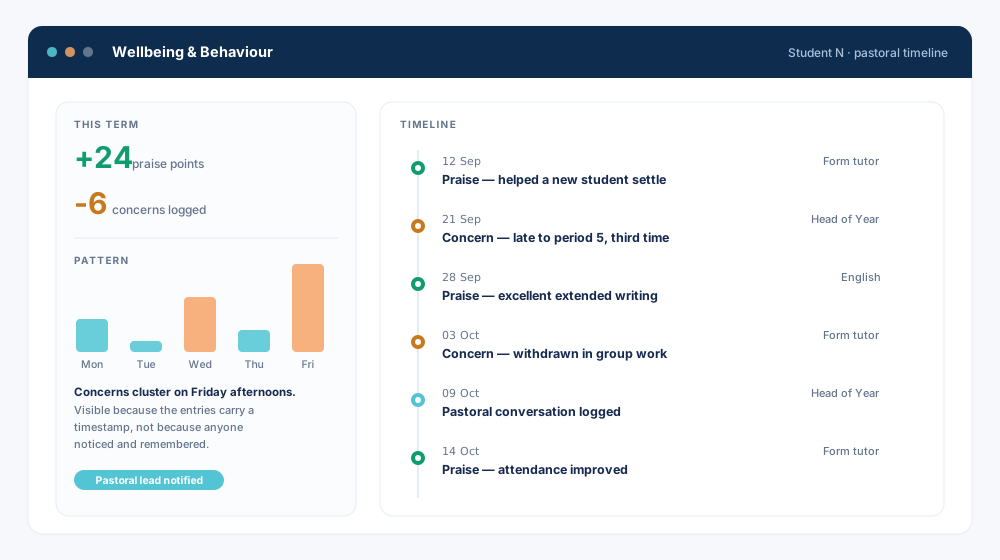
Behaviour systems tend to be built for the school and justified for the child. The points are counted, the reports are produced, and the thing that would actually help — noticing that a particular child struggles on Friday afternoons — requires someone to spot it unaided.
The difference between a behaviour system and a pastoral record is whether the pattern is visible without anyone having to look for it.
The total is the least useful number
A running total answers “how is this child doing?” with a figure that could describe several completely different children. Twenty-four praise entries and six concerns is a child having a good term with a difficult patch. The same net figure could be a child with nothing recorded either way and one serious incident.
Netting positives against negatives destroys the information that made the record worth keeping. Hold both, show both, and do not reduce them to one score.
Patterns need timestamps, not tallies
The genuinely useful observations in pastoral data are temporal:
- Concerns clustering on one weekday, or in one period.
- A change in frequency that begins in a specific week.
- Positive entries stopping, which is quieter and more significant than negative ones starting.
- Entries concentrated with one member of staff, which is information about the relationship rather than the child.
None of these appear in a total. All of them appear immediately in a timeline, and the timeline costs nothing extra — the entries already carry a date. Our wellbeing and behaviour module shows the pattern alongside the count for exactly this reason.
The fourth pattern is the uncomfortable one
A record showing that most of a child’s concerns come from one teacher is a difficult thing for a school to look at. It may mean the teacher sees the child more. It may mean the teacher has a lower threshold. It may mean something about the relationship that would benefit from a conversation.
Whatever the explanation, a system that makes it visible is doing its job, and a school willing to look at it is a school where the record serves the child rather than the file.
Positive entries are the ones that lapse
Negative entries get logged because they need following up. Positive ones get logged when someone remembers. Within a term this asymmetry produces a record that describes a school full of problems, which is both inaccurate and demoralising to read.
The fix is friction, not policy: if logging praise takes three taps and logging a concern takes three taps, the ratio in the data starts to resemble the ratio in the building.
What the record is for
The test of a pastoral record is whether it changes what happens to a child. A concern logged and never revisited is administration. A pattern surfaced to a form tutor who then has a conversation is the entire point.
Related reading: maintained versus reconstructed evidence makes the same argument about timing: a pattern recorded as it develops can be acted on, and the same facts assembled afterwards only prove they were always there.
Frequently asked questions
Do points systems work?
They work as a data-capture mechanism and poorly as a motivator. The value is that something gets logged consistently; the risk is that the number becomes the conversation. A school that discusses a child’s total rather than their pattern has let the instrument replace the observation.
Should positive and negative entries share one scale?
They should share one timeline but not net off against each other. A child with twenty-four praise entries and six concerns is not the same as a child with eighteen and none, and a single balance figure hides exactly the pattern a pastoral lead needs to see.
Who should be able to log an entry?
Any member of staff who sees something worth recording, which is the only way the record reflects the day rather than one person’s route through it. What needs restricting is not who can add, but who can see the accumulated picture.
Keep reading
Where Admissions Enquiries Stall, and What It Costs
Most schools can tell you how many students enrolled. Fewer can tell you how many families enquired, and fewer still can say where the ones who did not enrol stopped.
OperationsA Nursery’s Paperwork Year, and Why September Hurts
A nursery’s paperwork does not arrive evenly. It arrives in September, all at once, and then again in fragments as visas renew, families move and consents expire.
OperationsThe Pickup Problem, and Why Memory Is the Wrong System
Recognition is genuinely good security when the same staff meet the same families daily. It fails in four predictable situations, none of which are unusual.
See it against your own school
A walkthrough configured to your curriculum, run by someone who can answer migration questions rather than defer them.
Book a demo