
A Nursery’s Paperwork Year, and Why September Hurts
A nursery’s paperwork does not arrive evenly. It arrives in September, all at once, and then again in fragments as visas renew, families move and consents expire.
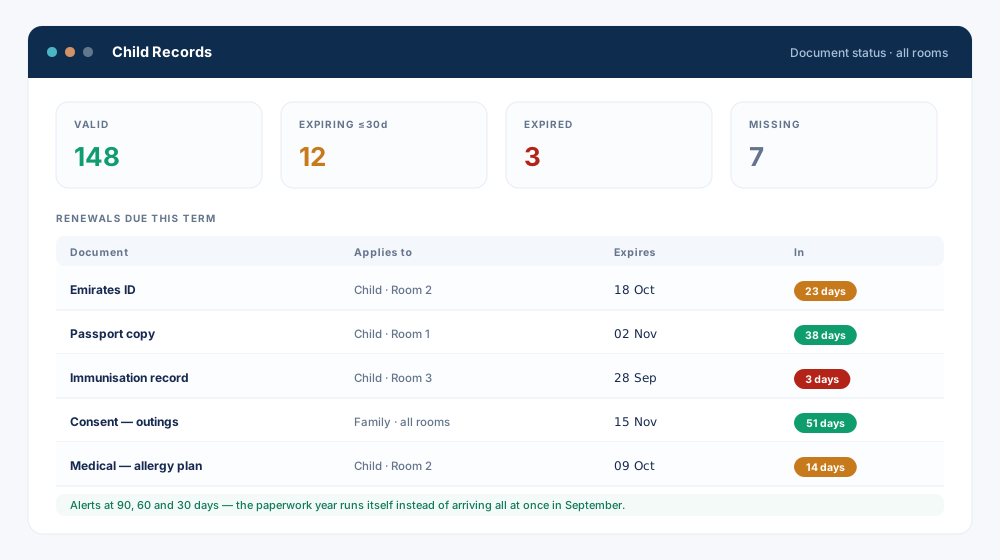
A nursery’s paperwork does not arrive evenly. It arrives in September, all at once, and then again in fragments through the year as visas renew, families move, allergies change and consents expire. Settings that survive this do not work harder in September. They stop treating the paperwork as an annual event.
What a UAE setting actually holds
The list is longer than most enrolment forms suggest, and each item has a different lifespan:
- Identity documents — Emirates ID and passport copies for the child, each with its own expiry, neither of which the nursery controls.
- Immunisation records — updated as the schedule progresses rather than collected once, which is why a single enrolment snapshot goes stale.
- Medical and allergy information — the highest-consequence record in the building, and the one most often held in two places.
- Consents — photography, outings, sun cream, emergency treatment. Some endure, some are per-event, and treating them identically is how a setting ends up unable to prove which applies.
- Authorised collectors — who may take this child home, which changes more often than any other field.
Expiry is a calendar problem, not a filing problem
Most settings file documents well. What breaks is that a filed document with an expiry date is a future task, and filing systems do not have opinions about the future.
The structural fix is alerting at ninety, sixty and thirty days, so a renewal becomes a series of small prompts rather than a discovery. A document that expires on a Tuesday should have been visible since three months before. Our student record holds documents with their expiry dates attached, which is what makes that possible without anyone maintaining a separate diary.
The three states that matter
Valid, expiring, expired — and a fourth that settings forget: missing. A document nobody has ever provided does not expire, so it never appears in an expiry report. It simply is not there, quietly, until someone asks for it.
A dashboard that counts all four is a different instrument from one that counts renewals. The missing column is usually the smallest and the most urgent.
Why this is not just administration
A nursery holds records about children who cannot advocate for themselves, in a jurisdiction with a clear data-protection framework. Under UAE PDPL, holding personal data lawfully means being able to show what you hold, why, and for how long. A filing cabinet cannot demonstrate a retention period; a record with dates attached can.
That is worth doing for its own sake. It also happens to be exactly what makes the September rush disappear, because a setting that maintains this continuously has nothing to assemble.
A test for the start of term
- Which children have a document expiring in the next sixty days?
- Which have a document that was never provided at all?
- If a parent updated an allergy last week, how many places did that change land in?
If the third answer is more than one, the setting has copies rather than a record — and copies are the version that is wrong when it matters. The nursery overview covers how the rest of the day fits around that record.
Frequently asked questions
How far ahead should document expiry alerts fire?
Ninety, sixty and thirty days is the pattern that works. Ninety gives a family time to start a renewal, sixty is a real reminder, and thirty is the point where the setting should be chasing rather than waiting. A single alert on the expiry date is not a warning, it is a notification of a problem.
Do consents need renewing, or is one signature enough?
It depends what was consented to. A photography consent given at enrolment is arguably still valid three years later; a consent for a specific outing is not. Holding them as one undifferentiated pile is what makes the question unanswerable when it is asked.
Where do allergy and medical records fit?
On the child record, visible to the staff who need them at the moment they need them, and versioned. A laminated sheet in the kitchen is a copy, and copies drift. The one that matters is the one that updates everywhere when a parent tells you something has changed.
Keep reading
The Pickup Problem, and Why Memory Is the Wrong System
Recognition is genuinely good security when the same staff meet the same families daily. It fails in four predictable situations, none of which are unusual.
OperationsAttainment, Progress and Value-Added: Three Numbers Schools Conflate
A student can be high-attaining and low-progress. A cohort can show strong progress and negative value-added. Those are not contradictions — they are three lenses, and conflating them produces reports that quietly say different things to different readers.
OperationsSEN Provision Mapping: What a Usable Map Holds
Most schools can produce a list of students on the inclusion register. Far fewer can produce what each of those students actually received last term, who delivered it, and whether it worked.
See it against your own school
A walkthrough configured to your curriculum, run by someone who can answer migration questions rather than defer them.
Book a demo