
SEN Provision Mapping: What a Usable Map Holds
Most schools can produce a list of students on the inclusion register. Far fewer can produce what each of those students actually received last term, who delivered it, and whether it worked.
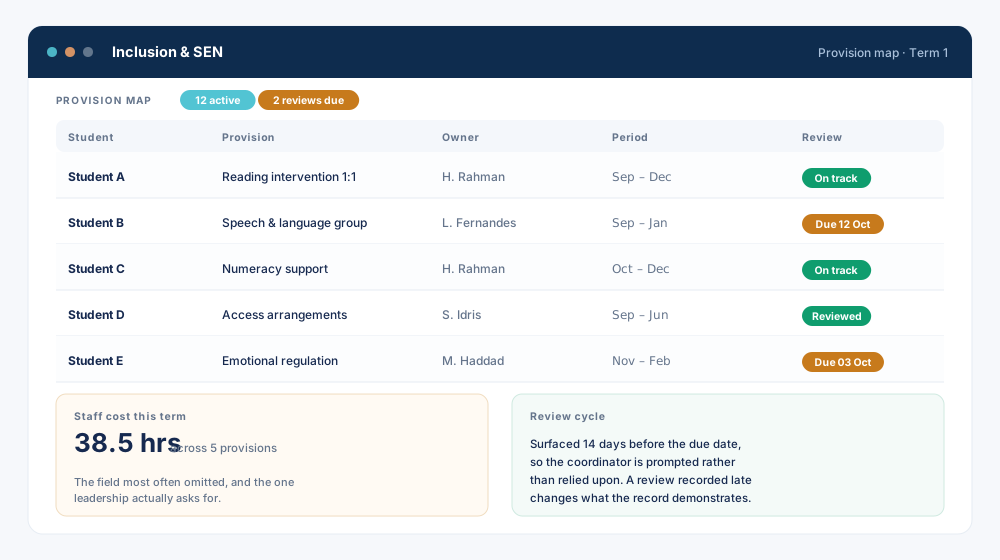
Most schools can produce a list of students on the inclusion register. Far fewer can produce, on request, what each of those students actually received last term, who delivered it, and whether it worked. The first is a register. The second is a provision map, and it is the one that gets asked for.
The difference, precisely
A register answers: who has an identified need? It is a list, and keeping it current is largely an administrative task.
A support plan answers: what does this student need? It is written per student, usually with targets and review dates.
A provision map answers: what did the school deliver? It links the plan to the intervention that actually ran — the sessions, the staff who delivered them, the weeks they covered, and the review that followed. It is the only one of the three that demonstrates the school did something, rather than intended to.
Schools with strong inclusion practice and weak provision mapping are common. The support is real; the record of it lives in a coordinator’s head, a shared drive and a timetable nobody exports. That is a documentation problem, not a practice problem, but under scrutiny the two are indistinguishable.
What a usable provision map holds
- The intervention, named and defined. Not “support” but a specific provision with a described purpose, so two coordinators would log the same thing the same way.
- Who delivered it. A named member of staff, because provision without an owner is the first thing to lapse when timetables change.
- The period it ran. Start and end, not just “this year”. A review cycle cannot be evidenced without dates.
- The review and its outcome. What changed, what did not, and what happens next. A map with no outcomes records activity rather than provision.
- The cost, in staff time. This is the field most often omitted and the one leadership most often needs, because it is the only route to answering whether provision is distributed sensibly.
Why the review cycle is where it breaks
Registers stay current because someone is responsible for them. Plans get written because a student joins and the need is fresh. Reviews lapse, because nothing surfaces them until a date has already passed.
A review recorded three weeks late is not a small administrative slip. It changes what the record demonstrates: not a cycle that ran, but a cycle reconstructed afterwards. The fix is structural rather than cultural — reviews scheduled and surfaced ahead of the date, so the coordinator is prompted rather than relied upon. That is how our inclusion and SEN module is built: plans carry owners, interventions carry dates, and reviews arrive before they are overdue.
Access, and why less is safer
Inclusion data is among the most sensitive a school holds. It frequently touches medical information, family circumstance and assessment history at once. A permission model that makes the register visible to all teaching staff is easy to build and hard to justify.
The defensible position is restricted access with a stated reason for each grant, and a record of who viewed what. Under UAE PDPL, being able to show the boundary is part of holding the data lawfully — and it is a question that arrives during diligence far more often than schools expect.
A short self-test
Ask your inclusion lead three questions and time the answers:
- Which students received reading intervention last term, and who delivered it?
- Which reviews are overdue right now?
- What did inclusion provision cost in staff hours last term?
If those take a fortnight and a spreadsheet, the school has provision but not a provision map. Closing that gap is mostly a matter of recording what already happens at the moment it happens — which is considerably cheaper than assembling it later, and the only version that stands up when read closely.
Related reading: maintained versus reconstructed evidence explains why the timeline matters as much as the content.
Related: inclusion leads.
Frequently asked questions
Is a provision map the same as an individual support plan?
No. A support plan describes what one student needs. A provision map describes what the school actually delivers, to whom, by whom and at what cost. Schools frequently have the first and not the second, which is why the question "what does inclusion cost us" is so often unanswerable.
How much detail should a provision map hold?
Enough to answer three questions: who received what, for how long, and what changed as a result. Detail beyond that tends to go unmaintained, and an unmaintained map is worse than a short one because it looks complete.
Who should be able to see the SEN register?
Fewer people than usually have access. The register carries some of the most sensitive data a school holds, and a permission model that grants it to every teacher by default is difficult to defend under UAE PDPL. Restricted access with a clear grant reason is the safer position.
Keep reading
Report Week Is a Diagnostic, Not a Deadline
A report card contains almost nothing new. If marks, attendance and comments already sit in one place in a usable form, generating it is a print job. If they do not, report week is where the reconciliation finally happens.
BuyingHow to Choose a Student Information System in the UAE
Most SIS shortlists are built on feature checklists, and feature checklists are where schools get caught. The differences that matter here are structural, and they only surface if you ask about them directly.
MigrationStudent Data Migration: What Actually Goes Wrong
Migrations rarely fail on the import. They fail on everything that was already wrong in the data, discovered halfway through, when the calendar has stopped being negotiable.
See it against your own school
A walkthrough configured to your curriculum, run by someone who can answer migration questions rather than defer them.
Book a demo