
Report Week Is a Diagnostic, Not a Deadline
A report card contains almost nothing new. If marks, attendance and comments already sit in one place in a usable form, generating it is a print job. If they do not, report week is where the reconciliation finally happens.
Report week is the same in most schools. Deadlines move, a spreadsheet circulates, someone reconciles marks against the register at eleven at night, and the reports go out a little late. It is treated as a seasonal inconvenience. It is actually a diagnostic: report week is when a school finds out whether its data was usable all along.
Assembly, not production
A report card contains almost nothing new. Marks were entered weeks ago. Attendance accumulated daily. Comments draw on work already assessed. If all of it sits in one place in a consistent form, producing the report is assembly — select the template, generate, check, publish.
The rebuild happens when the inputs live in different places and disagree. Then report week is not assembly at all. It is the reconciliation that should have happened continuously, compressed into four days by a deadline.
The three inputs that cause the overrun
- Marks entered twice. Once in a departmental spreadsheet, once in the system, with the spreadsheet treated as authoritative. Every discrepancy is then a judgement call made at speed.
- Weighting that lives in someone’s method. If the model for combining coursework and examination is applied by hand, two teachers will apply it differently and nobody will know which report is right.
- Comments written from nothing. A teacher facing thirty blank boxes at the end of term produces thirty rushed sentences. The bottleneck is not writing ability; it is starting from zero, thirty times.
What comment banks are for
A comment bank is often dismissed as a route to generic reports. Used badly it is exactly that. Used well it removes the blank page and leaves the teacher to do the part only they can: the specific observation about this student.
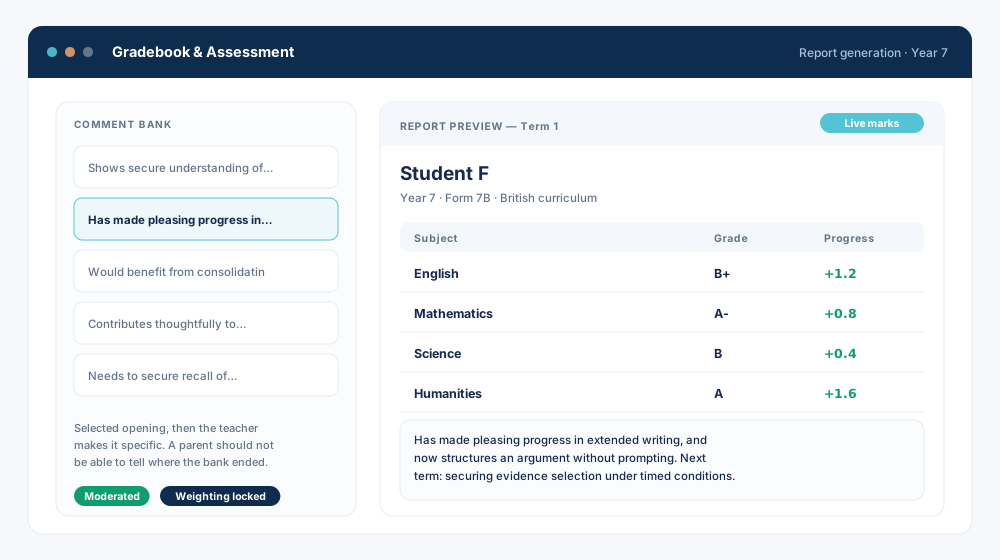
The useful shape is a bank of opening statements organised by subject and attainment band, which the teacher selects and then makes particular. A parent reading it should not be able to tell where the selection ended, because the specific half carries the meaning. A bank that produces the entire comment fails that test immediately.
Moderation, before the report and not after
Moderation asks whether the same work would earn the same mark from a different teacher. It is a check on consistency, and it belongs before reports are generated rather than after a parent has queried one.
Schools that moderate late tend to discover the problem in the most expensive way: a family with two children compares two reports and finds the standard has moved. At that point the conversation is no longer about a mark. It is about whether the school’s assessment can be trusted, which is a much harder position to recover.
Our gradebook and assessment module holds weighting, moderation and comment banks in the same place as the marks, so the report is generated from the record rather than assembled alongside it.
Templates that survive a curriculum
A school running more than one curriculum needs more than one report format, and the formats are genuinely different — different grade scales, different reporting cycles, different expectations about what a comment covers. A single template bent to cover both produces a document that serves neither set of parents well.
The workable answer is templates per year group and curriculum, generated from live marks. The alternative — one master document edited per cohort — is where version drift starts, and version drift is what produces two reports with different footers in the same envelope.
The test worth running
Before the next reporting cycle, ask for a single student’s report to be generated on an ordinary Tuesday, with no notice. If it can be produced in minutes and it is correct, report week will be assembly. If it cannot, the work that report week is about to compress is already visible — and it is cheaper to fix in an ordinary week than in the four days before a deadline.
Related reading: the three progress numbers schools conflate covers what those marks should add up to once they are in one place.
Frequently asked questions
Do comment banks make reports impersonal?
They do if the bank is the whole comment. Used as a starting sentence that a teacher then makes specific, they remove the blank-page problem without removing the teacher. The test is whether a parent could tell which part was selected and which was written.
What is moderation actually checking?
That the same piece of work would receive the same mark from different teachers. It is a consistency check on the marking, not a second opinion on the student. Schools that skip it usually discover the inconsistency at the point a parent compares two siblings.
Why does report week always overrun?
Because it is treated as a production task rather than an assembly task. If marks, attendance and comments already sit in one place in a usable form, generating a report is a print job. If they do not, report week is where the reconciliation finally happens.
Keep reading
How to Choose a Student Information System in the UAE
Most SIS shortlists are built on feature checklists, and feature checklists are where schools get caught. The differences that matter here are structural, and they only surface if you ask about them directly.
MigrationStudent Data Migration: What Actually Goes Wrong
Migrations rarely fail on the import. They fail on everything that was already wrong in the data, discovered halfway through, when the calendar has stopped being negotiable.
CurriculumRunning Two Curricula on One Campus
Multi-curriculum campuses are ordinary in the UAE and awkward in most software. The problem is not capacity — it is that the assessment models genuinely disagree with each other.
See it against your own school
A walkthrough configured to your curriculum, run by someone who can answer migration questions rather than defer them.
Book a demo