
The Pickup Problem, and Why Memory Is the Wrong System
Recognition is genuinely good security when the same staff meet the same families daily. It fails in four predictable situations, none of which are unusual.
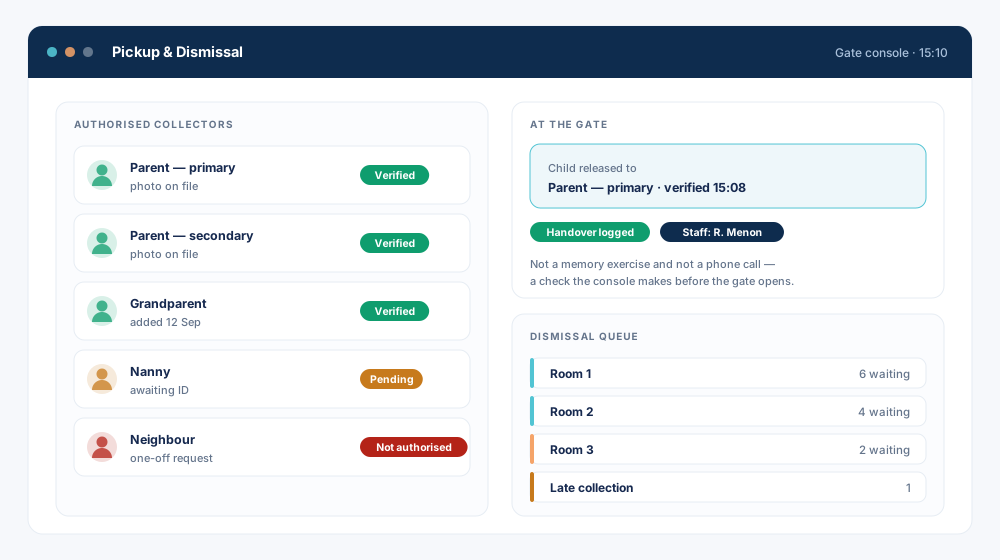
Dismissal is the busiest fifteen minutes of a nursery day and the one with the highest consequence of error. It is also, in most settings, the process that runs most on memory: staff who know the families, a signup sheet from September, and a phone call whenever someone unfamiliar appears at the gate.
That works, until the day it does not — and the reason it eventually does not is structural rather than careless.
Why memory is the wrong system
Recognition is genuinely good security when the same staff meet the same families daily. It fails in four predictable situations, none of which are unusual:
- A staff member is absent and the cover does not know the family.
- A new child joined last week and nobody has learned the household yet.
- The collector is authorised but has never come before.
- Two families share a surname, which happens more often than anyone plans for.
Each of these turns a fifteen-minute dismissal into a queue and a phone call, and a queue under time pressure is where judgement gets rushed.
What the record should show
A defensible handover record answers four questions, and it answers them without anyone reconstructing the afternoon:
- Who collected — the named person, not “parent”.
- That they were authorised — checked before release, not assumed after.
- Who released the child — the staff member, so the handover has two ends.
- When — a timestamp, which is the field that makes a late collection visible as a pattern rather than an anecdote.
A signature book records the first and, weakly, the fourth. It cannot record the second at all, because the person signing is the person being verified.
The one-off is the normal case
Settings design for the standing list and treat variation as an exception. In practice the variation is constant: a delayed parent, a visiting relative, a nanny’s day off. If the only path for a one-off is an office phone call, the design is fighting the actual day.
Handling it properly means a parent can add or approve a collector through a route the setting controls, with the change logged and visible at the gate before the queue forms. Our parent portal is where that request originates, and the gate console is where it lands — the same record, two ends.
Late collection is a safeguarding signal, not a billing one
Most settings track late collection because of fees. The more useful reading is the pattern: a family late once is a traffic jam, a family late repeatedly is information, and the difference is only visible if the timestamps accumulate somewhere.
This is the same argument that runs through maintained versus reconstructed evidence: a pattern recorded as it develops can be acted on. The same facts assembled afterwards only demonstrate that they were always there.
Three questions for your own gate
- If an unfamiliar adult arrives for a child, what happens in the next thirty seconds?
- Can you show who collected a specific child on a specific afternoon last term?
- Who added the most recent authorised collector, and on whose instruction?
A setting that answers all three quickly has a handover process. One that answers none has a routine that has worked so far — and the nursery overview covers the rest of the record that should sit behind it.
Frequently asked questions
Is a signature at the gate enough of a record?
It records that someone collected, not that the right person did. A signature is provided by the collector, which means it verifies nothing about their authorisation. What matters is the check that happened before the gate opened, and whether that check is recorded.
How should one-off changes be handled?
As a first-class case rather than an exception. A grandparent collecting once because a parent is delayed is the single most common real-world event at dismissal. If the only route is a phone call to the office, the queue stops and staff improvise — which is exactly when mistakes happen.
Who should be able to add an authorised collector?
A parent or guardian, through a route the setting controls, with the addition logged. Staff adding collectors on a verbal request is how an unverified name enters the list, and the log is what makes that reviewable afterwards.
Keep reading
Attainment, Progress and Value-Added: Three Numbers Schools Conflate
A student can be high-attaining and low-progress. A cohort can show strong progress and negative value-added. Those are not contradictions — they are three lenses, and conflating them produces reports that quietly say different things to different readers.
OperationsSEN Provision Mapping: What a Usable Map Holds
Most schools can produce a list of students on the inclusion register. Far fewer can produce what each of those students actually received last term, who delivered it, and whether it worked.
OperationsReport Week Is a Diagnostic, Not a Deadline
A report card contains almost nothing new. If marks, attendance and comments already sit in one place in a usable form, generating it is a print job. If they do not, report week is where the reconciliation finally happens.
See it against your own school
A walkthrough configured to your curriculum, run by someone who can answer migration questions rather than defer them.
Book a demo