
Where Admissions Enquiries Stall, and What It Costs
Most schools can tell you how many students enrolled. Fewer can tell you how many families enquired, and fewer still can say where the ones who did not enrol stopped.
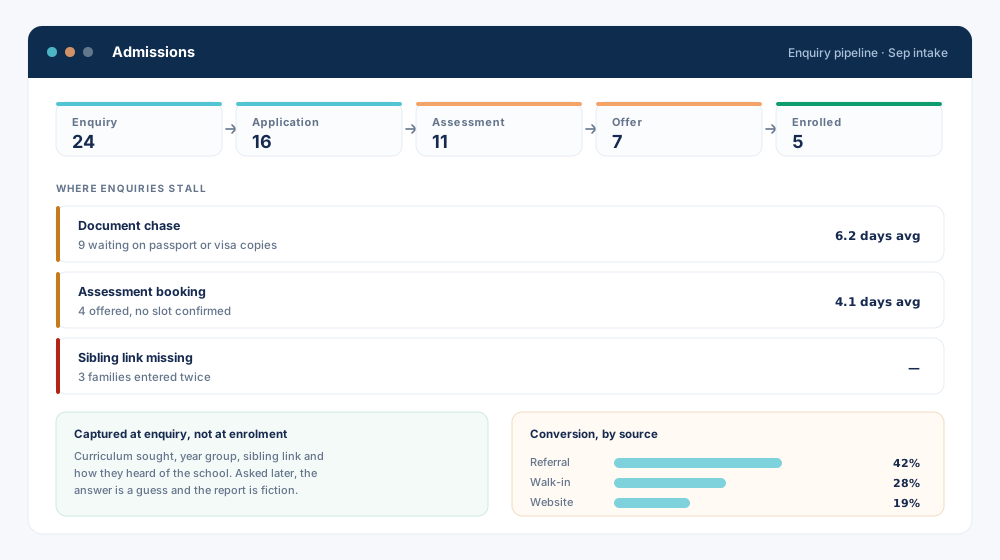
Most schools can tell you how many students enrolled. Fewer can tell you how many families enquired, and fewer still can say where the ones who did not enrol stopped. That gap is not a reporting inconvenience. It is the difference between managing admissions and observing it.
Enquiries do not fail, they stall
Families rarely decide against a school in a single moment. They go quiet. A document was requested and never chased, an assessment slot was offered and never confirmed, a follow-up was owed by someone who assumed someone else had it.
Every one of those is recoverable, and every one of them is invisible unless the pipeline records not just the stage a family is in but how long they have been in it. A stage with no clock is a list, and lists do not surface the family who has been waiting eleven days.
The three places families go quiet
- The document chase. Passport copies, visas, previous school reports. Nobody owns the follow-up because it is nobody’s job specifically, and the family interprets silence as disinterest.
- The assessment gap. An assessment is offered, a slot is not confirmed, and two weeks pass. The family has usually applied elsewhere in that window.
- The sibling assumption. A second child is entered as a fresh enquiry because nobody linked the household. The family receives a first-contact sequence they find slightly insulting, and the school later has two records for one address.
Capture at enquiry, not at enrolment
The fields that make admissions reporting useful have to be captured at the point of enquiry, because that is the only time the answer is real:
- Curriculum sought — shapes the tour, the follow-up and the eventual placement.
- Year group and intended start — a September enquiry for January is not a lost lead.
- Sibling link — the strongest conversion signal a school has.
- How they heard of the school — the only route to knowing which channel is worth the spend.
Reconstructed at enrolment, each of these becomes a guess. A conversion report built on guesses is worse than no report, because it will be believed. Our admissions module captures them at first contact and carries them through to the student record, so the enquiry and the enrolled child are the same object rather than two.
Conversion by source is the only number that changes behaviour
A single conversion percentage tells leadership almost nothing. Split by source, it tells them where to spend. If referrals convert at more than double the rate of any paid channel, the next decision is obvious and it is not about advertising.
This requires only that the source field is populated and never overwritten. It is a small discipline with a disproportionate payoff, and it is almost always the field that gets left blank when the office is busy — which is exactly when the enquiries matter most.
What to ask your registrar this week
- Which families are waiting on us right now, and for how long?
- How many enquiries this term came from an existing family?
- Of the families who did not enrol, at which stage did each stop?
If the third question cannot be answered, the school is not losing families for unknown reasons. It is losing the record of why — and that is a fixable problem, unlike the families themselves.
Related reading: what goes wrong when student data moves between systems covers the duplicate-record problem this post touches on, from the other end.
Related: admissions teams.
Frequently asked questions
What is a realistic enquiry-to-enrolment conversion rate?
It varies too much by school, intake and market position for a benchmark to be useful. The number worth tracking is your own, by source, over time. A school that knows its referral enquiries convert at three times its walk-ins can make a decision; a school comparing itself to an industry average cannot.
Should the pipeline capture curriculum preference at enquiry?
Yes, and it is the field most often added too late. Asked at enquiry it is a real answer that shapes the tour and the follow-up. Reconstructed at enrolment it is an assumption, and any report built on it inherits the assumption.
How do sibling links affect the pipeline?
A sibling enquiry is not a cold enquiry, and treating it as one wastes the strongest signal a school has. If the link is not captured at entry the family gets a generic sequence, and the record duplicates when the second child enrols.
Keep reading
A Nursery’s Paperwork Year, and Why September Hurts
A nursery’s paperwork does not arrive evenly. It arrives in September, all at once, and then again in fragments as visas renew, families move and consents expire.
OperationsThe Pickup Problem, and Why Memory Is the Wrong System
Recognition is genuinely good security when the same staff meet the same families daily. It fails in four predictable situations, none of which are unusual.
OperationsAttainment, Progress and Value-Added: Three Numbers Schools Conflate
A student can be high-attaining and low-progress. A cohort can show strong progress and negative value-added. Those are not contradictions — they are three lenses, and conflating them produces reports that quietly say different things to different readers.
See it against your own school
A walkthrough configured to your curriculum, run by someone who can answer migration questions rather than defer them.
Book a demo