
Teacher Cover, and Why the Same Person Always Says Yes
Poorly distributed cover does not announce itself. The signal arrives later and in a different form: a resignation, a grievance, or a reluctance that reads as attitude when it is arithmetic.
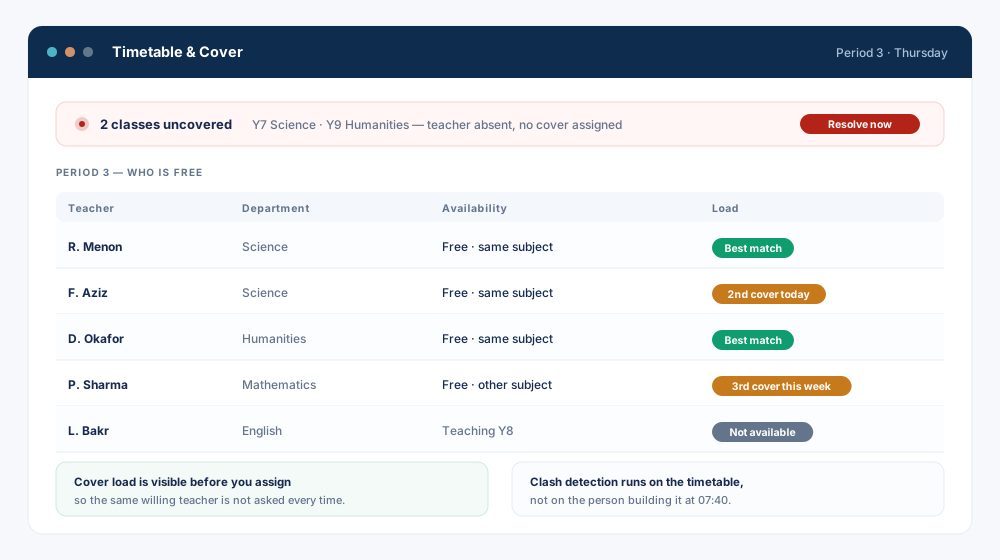
In most schools cover is arranged between 07:40 and the first bell, by one person, from memory, using a printed timetable and a phone. It works because the person doing it is good at it. That is also precisely the risk.
Three different problems wearing one name
“Cover” bundles three situations that need different handling:
- Planned absence — training, appointments, exam duties. Known well ahead, and there is no reason for it to be resolved in the morning window at all.
- Same-day absence — genuine short notice. This is the only category that belongs at 07:40.
- Partial absence — a teacher present but withdrawn for a meeting or a trip. The hardest to see, because the person is in the building.
Schools that feel permanently in crisis about cover are usually resolving the first category in the third category’s timeframe.
Two facts, needed together
Allocating cover well requires knowing who is free and who has already carried the load. Either alone produces a bad decision. Availability alone sends the same willing teacher back for the third time this week; fairness alone puts a mathematician in front of a Year 9 science class when a scientist was free two doors away.
Neither fact is difficult to hold. They are simply held in different places — the timetable and somebody’s sense of who has been asked lately — and only one of them is written down. Our timetable and scheduling module puts availability and cover load in the same view, so the choice is made with both visible rather than one remembered.
The invisible cost
Poorly distributed cover does not announce itself. There is no report that says a department has absorbed forty per cent of the term’s cover. The signal arrives later and in a different form: a resignation, a grievance, or a quiet reluctance that reads as attitude when it is actually arithmetic.
A running count per teacher costs nothing to maintain if the system already knows who was assigned. It is the single most useful number in the whole process, and almost no school has it to hand on a Thursday morning.
Clash detection belongs to the timetable, not the person
The other failure at 07:40 is double-booking — assigning a teacher who is free in the published timetable but committed to something the timetable does not know about. A trip, an intervention group, a scheduled meeting.
If those commitments live in the timetable, the clash is caught by the system. If they live in a calendar the cover manager does not open, the clash is caught by a teacher arriving at a classroom that already has one.
What good looks like
A school with cover under control can answer three things quickly:
- Which classes are uncovered right now, this period?
- Who has covered most this term, and by how much?
- What proportion of this term’s cover was known more than a day in advance?
The third is the diagnostic. A high number means the morning scramble is largely self-inflicted — and that is good news, because it is the kind of problem a process can fix without hiring anyone.
Frequently asked questions
Why does the same teacher always end up covering?
Because cover is allocated by memory under time pressure, and memory reaches for whoever said yes last time. Without a visible load count the fairest-seeming decision each morning produces an unfair distribution by half term, and the person carrying it usually says nothing until they resign.
Is same-subject cover worth prioritising?
Where it is available, yes — the lesson continues rather than becoming supervised study. But an available same-subject teacher who has already covered twice that week is not obviously the right answer. Both facts have to be visible at the same time for the choice to be a real one.
How far ahead can cover realistically be planned?
Planned absence — training, appointments, examinations — is known days or weeks out and should never be resolved on the morning. Only genuine same-day absence belongs in the 07:40 window, and in most schools it is a minority of the cover actually arranged there.
Keep reading
Behaviour Records That Help the Child, Not the File
The difference between a behaviour system and a pastoral record is whether the pattern is visible without anyone having to look for it.
OperationsWhere Admissions Enquiries Stall, and What It Costs
Most schools can tell you how many students enrolled. Fewer can tell you how many families enquired, and fewer still can say where the ones who did not enrol stopped.
OperationsA Nursery’s Paperwork Year, and Why September Hurts
A nursery’s paperwork does not arrive evenly. It arrives in September, all at once, and then again in fragments as visas renew, families move and consents expire.
See it against your own school
A walkthrough configured to your curriculum, run by someone who can answer migration questions rather than defer them.
Book a demo