
The Bus Manifest Problem: A Headcount Is Not a Register
A count cannot distinguish between the right twenty-two children and twenty-two children. If one boarded the wrong bus and another was absent, the arithmetic works perfectly and the record is wrong.
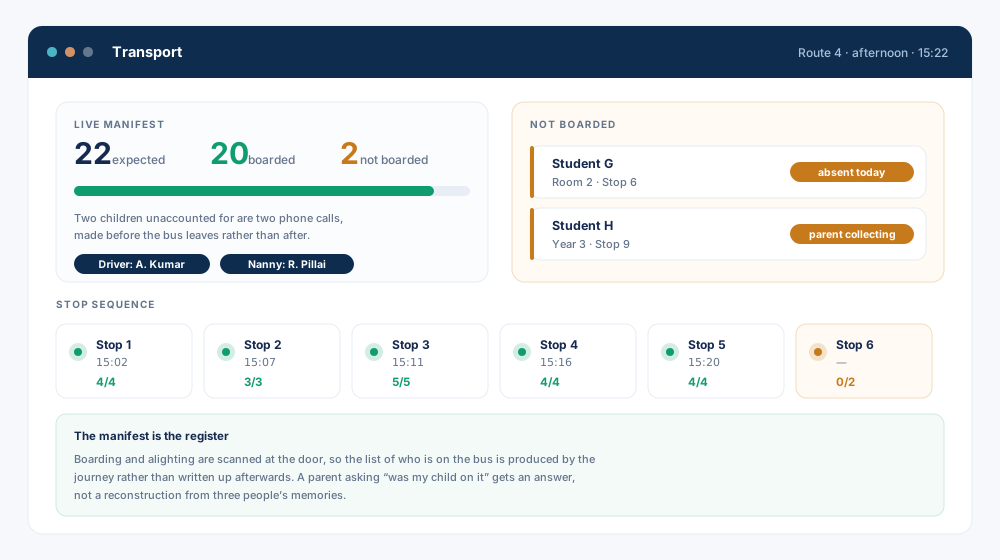
School transport is the part of the day where a child is furthest from both the school and the parent, supervised by the fewest adults, and recorded — in most settings — on a printed list with ticks on it. The list is usually right. The problem is what happens on the day it is not.
A headcount is not a register
The most common transport record is a count: the number of children who boarded, checked against the number expected. When those numbers match, everyone relaxes.
But a count cannot distinguish between the right twenty-two children and twenty-two children. If one child boarded the wrong bus and another was absent, the arithmetic works perfectly and the record is wrong in the only way that matters. A register names people. A count does not.
What the manifest has to answer
A transport record earns its keep when it can answer four questions without anyone reconstructing the afternoon:
- Who was expected on this route, on this day — which is not the same as who is on the route normally.
- Who actually boarded, by name, and at which stop.
- Who did not, and whether anyone established why before the bus left.
- Who alighted where, because a child who boards and does not get off at their stop is the scenario the whole system exists for.
The fourth is the one paper lists handle worst, because ticking someone on is a single action and nobody ticks them off.
The two-minute window that matters
The valuable moment is not the journey. It is the two minutes before departure, when a child is expected and not present. Handled then, it is a phone call to a parent who says the child is being collected today. Handled on arrival, it is a search.
That only works if the gap is visible at the door rather than discoverable later, which means the expected list has to be current for today and not for a term-start assumption. Our transport module builds the manifest from the same student record the office works from, so a same-day change reaches the bus rather than living in an email nobody on the vehicle can read.
Same-day change is the normal case
Settings design transport around the standing arrangement and treat variation as an exception. In practice the variation is daily: clubs, appointments, a parent in the area, a sibling arrangement that shifts for a week.
If the only route for a change is a phone call to the office at 14:50, the office becomes a bottleneck at precisely the busiest moment, and staff on the vehicle make judgement calls without the information. That is not a discipline problem. It is a design that does not match the day.
The record is worth more than the reassurance
Most of the value of a manifest is realised on ordinary days, when nothing goes wrong and nobody looks at it. Its worth appears the first time a parent asks a specific question about a specific afternoon — and the answer is either a timestamped record or three people trying to remember a Tuesday.
This is the same argument as the pickup problem at the gate: a check made before release, recorded as it happens, is a different instrument from a signature collected afterwards.
Three questions for your transport lead
- If a child does not board today, who knows, and when?
- Can you show who was on Route 4 last Tuesday afternoon?
- When a parent changes an arrangement at 14:45, what reaches the driver?
A school that answers all three has transport accountability. One that answers none has a list that has been right so far.
Frequently asked questions
Is a headcount not enough?
A headcount tells you how many children are on the bus. It does not tell you which ones, and the gap between those two facts is the entire problem. Twenty-two boarded when twenty-two were expected is reassuring right up until the moment it turns out two of them were the wrong two.
What about children whose plans change during the day?
That is the normal case, not the exception. A parent collecting instead of the bus, an after-school club, a sibling arrangement — if the manifest cannot absorb a same-day change, staff will work around it, and the workaround is what leaves no record.
Who should be able to see the live manifest?
The driver and the nanny on the vehicle, and the office. Parents should see their own child, not the list. A manifest visible to every parent is a roster of other people’s children with their movements attached, which is not a document a school should be distributing.
Keep reading
What a School Nurse Log Should Record, and Why
A visit note written at the end of the day records that something happened. One written at the time records what was known when the decision was made — different documents when a parent asks why.
OperationsTeacher Cover, and Why the Same Person Always Says Yes
Poorly distributed cover does not announce itself. The signal arrives later and in a different form: a resignation, a grievance, or a reluctance that reads as attitude when it is arithmetic.
OperationsBehaviour Records That Help the Child, Not the File
The difference between a behaviour system and a pastoral record is whether the pattern is visible without anyone having to look for it.
See it against your own school
A walkthrough configured to your curriculum, run by someone who can answer migration questions rather than defer them.
Book a demo