
Who Actually Uses a School System, and for What
The gap between who buys a school system and who uses it is the single best predictor of how the implementation goes — and it is almost never discussed during selection.
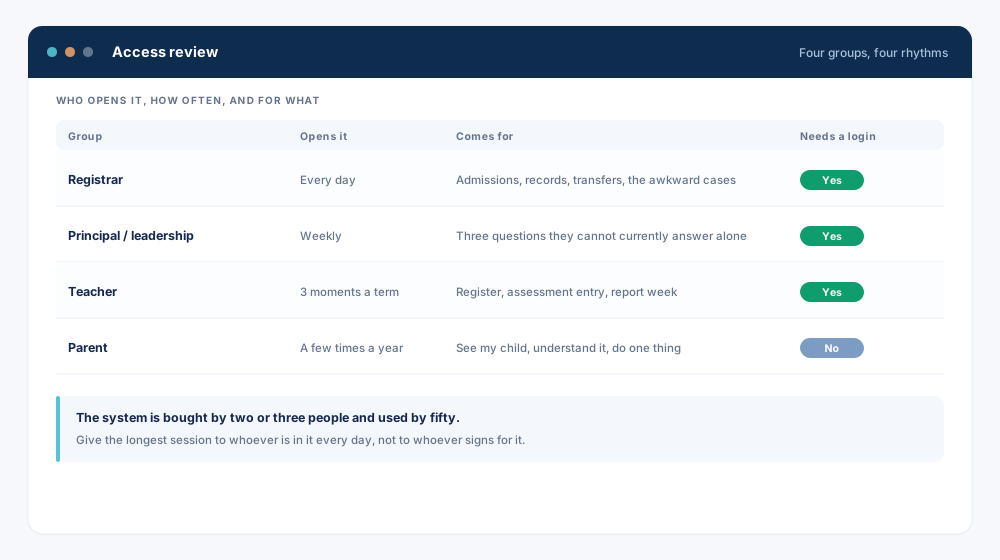
A school system is usually bought by two or three people and used by fifty. That gap is the single best predictor of whether the implementation goes well, and it is almost never discussed during selection — because every demo is naturally arranged around whoever is in the room.
Here is what each group actually does with it, how often, and what they will forgive.
The registrar: daily, and unforgiving about clicks
The registrar or data manager is in the system every working day, often for most of it. Their work is admissions correspondence, enrolment records, transfers in and out, document chasing, and being the person everyone else asks when a record looks wrong.
What they care about is the shape of the ordinary task. Adding a sibling to an existing family should not require re-entering the family. A student who arrives in February should not need the same twelve screens as one who joined in September. Finding a record by any of the four spellings of a name should work, because in this region all four are in use.
They will forgive an ugly interface and will not forgive an extra click on something they do forty times a day. If you want to know whether a system is good, put the registrar in front of it with a real week’s work and watch where they sigh.
The principal: weekly, and asking a different kind of question
Leadership uses the system in bursts, and almost never to enter anything. The questions arrive from above and outside: how is this year group tracking, why has attendance in one phase drifted, what does the pattern look like since the intervention, what will we be asked about next term that we cannot currently answer.
The failure mode here is subtle. Most systems can produce the answer; the question is whether it takes ninety seconds or an email to the registrar. A leadership team that has to ask somebody for every number stops asking, and the system quietly becomes an administrative tool rather than a management one.
What a principal actually needs is a small number of questions answerable without help, with the qualification attached — small cohorts labelled as small, incomparable scales not silently averaged. A dashboard that flatters is worse than no dashboard, because decisions get made on it.
The teacher: three moments a term, under time pressure
Teachers are the largest group and the lightest users, and their whole experience is concentrated into a few high-pressure windows: taking the register, entering assessment, and writing reports. Everything else is optional and will be skipped.
Which means teacher-facing design is judged almost entirely on those three. Report-writing week is the real test — that is when forty people use the system hard, simultaneously, on whatever device is nearest, at the end of a long term. A system that is pleasant in September and painful in that week will be described by its users as painful, and they will be right.
The parent: rarely, and never trained
Parents are the group with no induction, no support channel and no patience, using it a handful of times a year, often on a phone, sometimes in a second or third language. Anything that needs explaining has already failed.
The realistic goal is narrow: see my child, understand what it says, do the one thing I came to do. Feature depth aimed at parents is usually wasted; clarity is not.
What this means for licensing
The four groups also settle a question that comes up in every pricing conversation: how many people need an account. It is a smaller number than the staff list and a larger one than the office, and it is worked out by asking who enters or approves something rather than who might like to look.
Counting that honestly before you talk to anyone changes the conversation, because you are then comparing quotes for the same thing rather than for three different assumptions about your school. What Scholyn costs is structured around that split rather than around headcount.
How to run the evaluation, given all that
- The registrar gets the longest session, with real tasks from a real week, unaccompanied by the vendor if possible.
- Leadership brings three questions they currently cannot answer without asking someone, and tries to answer them unaided.
- Two teachers do a report cycle — not a walkthrough of one. The difference between those two is the entire point.
- Someone looks at the parent view on a phone, having been told nothing about it.
Half a day, four people, and it surfaces more than a month of vendor calls — because it tests the thing that decides success. Not whether the system can do it, but whether the person who has to do it forty times a day will still be doing it properly in March.
Frequently asked questions
Who should lead the evaluation?
Whoever will use it most, which is almost never whoever signs for it. The registrar or data manager is in the system every day and will find in an hour what a leadership demo will not surface in a term. Leadership still decides; they should not be the only ones looking.
How many people actually need a login?
Fewer than the headcount and more than the office. Work it out by asking who needs to enter or approve something rather than who might like to look. That number, not your staff total, is what a licensing conversation should start from.
What is the most common evaluation mistake?
Buying a system that answers the principal’s questions beautifully and makes the registrar’s day worse. It shows up six months later as data quality, because the person maintaining the data has stopped enjoying maintaining it.
Keep reading
Opening a Second Campus in Another Emirate
A second campus is treated as a property and staffing project. It is also a data project nobody scoped, and the decisions are far cheaper before it opens than after.
OperationsThe Bus Manifest Problem: A Headcount Is Not a Register
A count cannot distinguish between the right twenty-two children and twenty-two children. If one boarded the wrong bus and another was absent, the arithmetic works perfectly and the record is wrong.
OperationsWhat a School Nurse Log Should Record, and Why
A visit note written at the end of the day records that something happened. One written at the time records what was known when the decision was made — different documents when a parent asks why.
See it against your own school
A walkthrough configured to your curriculum, run by someone who can answer migration questions rather than defer them.
Book a demo