
An iSAMS Alternative for UAE Schools: What to Ask
Schools rarely go looking because the software failed. They go looking because the school changed shape and the software did not — a second curriculum, a second campus, a different reader.
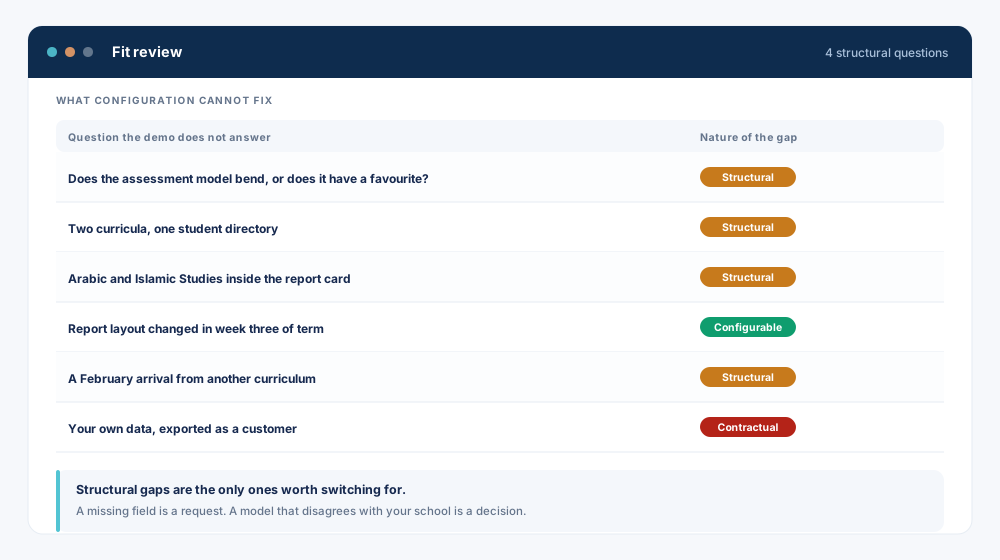
Schools rarely search for an alternative because the software failed. They search because the school changed shape and the software did not — a second curriculum was added, a second campus opened, or the reporting a board now expects stopped resembling the reporting the system was built to produce.
iSAMS was designed around the British independent school: houses and tutor groups, boarding where it applies, a pastoral record that runs alongside the academic one, and an examinations cycle organised around UK awarding bodies. Those are real, well-modelled ideas, and a school organised that way is well served by them.
The friction starts when a UAE school is only partly that school. Below are the four questions that decide it. None of them appear on a feature matrix, because every system answers yes to the categories they sit inside.
1. Does the assessment model bend, or does it have a favourite?
Every system claims to support multiple curricula. What that usually means is that you can rename a percentage field. The difference shows up in how a grade is arrived at:
- Criterion-based assessment records achievement levels against defined criteria, and the reported grade is determined from those levels — not averaged out of marks. A system that stores a single number per assessment cannot reconstruct it.
- Points-and-grade-boundary models need the boundaries themselves to be data, because they move between sessions. Hard-coded boundaries turn every review cycle into a support ticket.
- Continuous and coursework-weighted models need weighting to live at the subject level, and to be visible to the teacher entering the mark rather than buried in a configuration screen only an administrator can open.
Ask the question concretely rather than generally. Take one real subject in one real year group, and ask to see the grade produced end to end — entry, calculation, and the line that appears on the report. A system that has a favourite model will reveal it in about ninety seconds.
2. Can a second curriculum run in parallel without a second database?
This is the question that separates UAE schools from the schools most international MIS products were built for. Running two curricula on one campus is ordinary here, and it is awkward in most software — a point worth reading in full in running two curricula on one campus.
The three things that break are consistent:
- One student directory, two academic structures. A sibling pair split across streams must appear once in admissions, once in finance and once at the gate, while sitting in two different assessment models.
- Two report cycles that do not align. Different terms, different cut-off dates, different publication weeks. A system with one global reporting calendar forces one stream to run on the other’s schedule.
- Aggregation that knows what it cannot add up. A whole-school attainment view across two incompatible grade scales is either carefully qualified or quietly wrong.
3. Where does the Arabic and Islamic Studies stream sit?
Every school in the country teaches a stream alongside its main curriculum, on its own assessment pattern, often with its own staff and its own head. In systems designed elsewhere it tends to arrive as an afterthought: an extra subject bolted onto the main structure, assessed the way everything else is assessed, and reported in a separate document.
The consequence is administrative rather than academic. Two documents mean two production runs, two proofreading passes and two sets of parent questions, every cycle, forever. A system that treats the stream as a first-class part of the report card removes a recurring cost that nobody budgeted for.
4. Who is the report card written for?
A report card is read by a parent who may not share the curriculum’s vocabulary, and the same underlying data has to serve an internal review that wants the opposite: raw levels, trend, and the comparison the parent version deliberately smooths. Systems built for a single national context often assume a single house style, because there was only ever one audience to satisfy.
Ask what happens when the school wants to change a report layout in week three of a term. If the answer routes through the vendor, budget for that answer every year.
What is genuinely hard to replace
It is worth being honest about the other side. A long-established platform accumulates things a newer one has not had time to grow: a deep module catalogue, an integration list, a community of schools that has already hit your problem, and years of accumulated configuration that encodes decisions nobody wrote down. Replacing it means re-deciding those things deliberately.
That is a real cost and it belongs in the comparison. It is also the argument for switching because the model is wrong rather than because a screen is ugly.
What to test before you commit
- Your most awkward year group, in the assessment model it actually uses.
- A student who arrives in February, mid-cycle, from a different curriculum.
- One full report cycle for both streams, produced as one document.
- An export of your own data, requested as a customer rather than as a prospect.
Those four tell you more than any comparison table, and the last one tells you what leaving would cost — which is the thing worth knowing before you arrive rather than after.
Where Scholyn fits, and where it does not
Scholyn is built for UAE schools specifically: more than one curriculum on one campus, the Arabic and Islamic Studies stream inside the report rather than beside it, and an evidence trail that is maintained continuously instead of reconstructed when someone asks. It is deliberately narrower than a full independent-school suite — see the platform overview for what it does module by module.
If your school is a boarding-led British independent school and your hardest problem is house and boarding administration, an established suite built around exactly that is the better answer, and we would rather say so here than three weeks into an evaluation. If your hardest problem is that two curricula and one student body do not fit the model your system holds, that is the problem we built for.
Disclaimer: this article is for informational purposes only and is not legal, regulatory or procurement advice. References to third-party products describe what those products were designed around, based on publicly available information, and may not reflect current features, pricing or capability. Product names and trademarks are the property of their respective owners, and nothing here is endorsed by or affiliated with them. Confirm specifics directly with each vendor before making a purchasing decision.
Frequently asked questions
Is iSAMS a bad system?
No, and a school that concludes that has usually misread its own situation. It is a mature platform built around a specific kind of school. The useful question is not whether it is good but whether your school is shaped like the one it was designed for.
We only need one thing changed. Is switching worth it?
Usually not. If the gap is a report layout or a missing field, ask for it before you shortlist anything. Switching is justified when the mismatch is structural — when the model the system holds is not the model your school runs — because that is the one thing configuration cannot fix.
What happens to years of historical exam and pastoral records?
Decide early which of it must be live and which only needs to be findable. Live data has to arrive in the new model, which is where the effort goes. Everything else can be exported once and kept read-only, and treating the whole archive as live is a common way to double a migration.
Keep reading
A PowerSchool Alternative for UAE Schools
The mismatch is not the curriculum. It is the district — a structure above the school that shapes half of what the software does, and that does not exist here.
MigrationMoving off SIMS in a UAE School: What Actually Moves
Find out how much of your database exists to satisfy a framework you do not operate under. Empty columns are cheap; repurposed ones are the expensive kind.
BuyingWho Actually Uses a School System, and for What
The gap between who buys a school system and who uses it is the single best predictor of how the implementation goes — and it is almost never discussed during selection.
Product names and trademarks are the property of their respective owners, and nothing here is endorsed by or affiliated with them.
See it against your own school
A walkthrough configured to your curriculum, run by someone who can answer migration questions rather than defer them.
Book a demo