
A PowerSchool Alternative for UAE Schools
The mismatch is not the curriculum. It is the district — a structure above the school that shapes half of what the software does, and that does not exist here.
Most comparison pages start by arguing that one product beats another. That framing is unhelpful here. PowerSchool is a mature platform with a clear design centre, and the reason UAE schools go looking is almost never that it stopped working. It is that the assumption underneath it does not describe them.
That assumption is the district. American school software grew up inside a structure where a school sits under a district, the district reports into a state, and a large share of what the software does is producing the returns that structure requires — enrolment counts, attendance in the categories the funding formula recognises, and standardised assessment results in the shape the state defined.
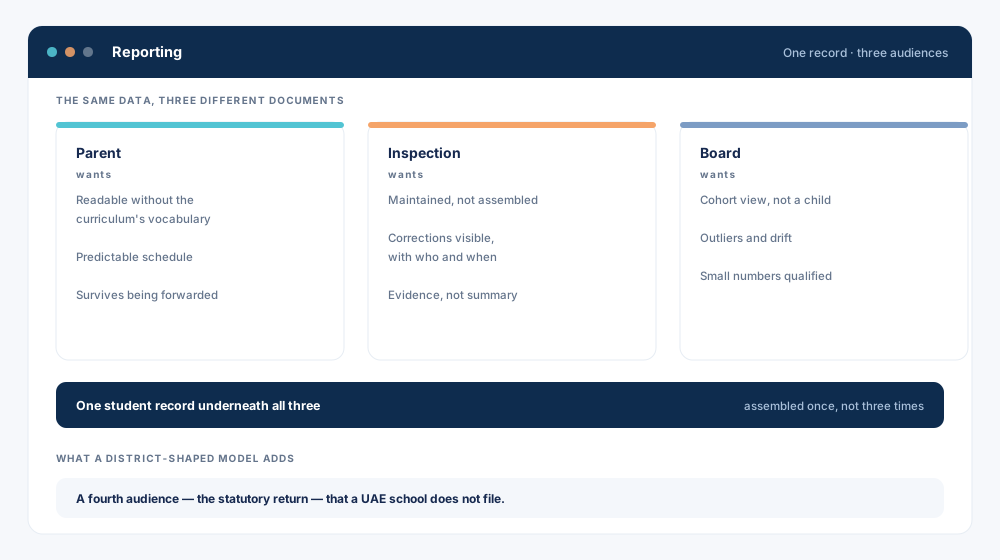
A school in the UAE has none of that above it, and three quite different audiences beside it.
Three audiences, three documents
This is the whole of the mismatch, and it is worth being specific because the three are usually collapsed into one word — “reporting” — during an evaluation.
- The parent wants a readable account of how their child is doing, in language that does not require the curriculum’s vocabulary, delivered on a predictable schedule and in a form that survives being forwarded to a grandparent.
- The inspection team wants evidence: not a summary produced last week, but a record that was maintained as things happened, including the corrections and who made them. Reconstructed evidence reads as reconstructed, a point covered at length in evidencing attendance and progress.
- The board or owner wants the cohort view — where a year group is drifting, which subject is an outlier, whether last term’s intervention did anything — with enough qualification that nobody mistakes a small cohort for a trend.
A system organised around a fourth audience that does not exist here will do all three, but each as a report you assemble rather than a view you open. That difference is invisible in a demo and expensive every single cycle.
What a transcript has to survive
UAE schools have high student mobility, and a transcript here has to absorb things a domestic one rarely meets:
- A student who arrives in February with eleven weeks of grades from a different school on a different scale.
- A student who moves between curricula inside the same school and needs one coherent history rather than two partial ones.
- A leaver whose next school will read the document without any context about how your grades were derived.
Ask to see all three. The second one in particular is the case a district-shaped model is least likely to have anticipated, because a district student who changes curriculum has usually changed school as well.
Whose gradebook is it?
Bundles are the other thing to examine deliberately. When the student information system, the gradebook and the learning platform ship together, the integration is genuinely smoother — and the exit is genuinely harder, because the grade of record now lives inside a suite you would have to leave all at once.
There is no universally right answer. There is a question worth asking out loud before you sign: if we keep the learning platform our teachers already like, what specifically stops working, and who owns the grade when the two systems disagree?
The Arabic and Islamic Studies stream
Every school here teaches a stream alongside its main curriculum, assessed on its own pattern. In a platform designed for a single national context it usually lands as an extra subject forced into the main assessment model, and the report becomes two documents.
Two documents is not a cosmetic problem. It is two production runs, two proofreading passes and two sets of parent queries, every reporting cycle, permanently.
What to test
- A February arrival from another curriculum, entered and reported end to end.
- One report cycle producing a single document covering both streams.
- An attendance record with a correction on it — shown to whoever would have to defend it.
- The cohort view a board actually asks for, built without a spreadsheet.
Where Scholyn fits, and where it does not
Scholyn is built for the UAE case rather than adapted to it: more than one curriculum on one campus, the Arabic and Islamic Studies stream inside the report card, and an evidence trail maintained continuously rather than assembled on request. The reporting and analytics module is organised around those three audiences rather than around a statutory return.
If you are a single-curriculum American school whose priority is a tightly integrated gradebook and learning platform from one vendor, a suite built for exactly that is the better fit and we would say so early. If your difficulty is that your school does not look like a district and your system keeps assuming it does, that is the gap we were built in.
Disclaimer: this article is for informational purposes only and is not legal, regulatory or procurement advice. References to third-party products describe what those products were designed around, based on publicly available information, and may not reflect current features, pricing or capability. Product names and trademarks are the property of their respective owners, and nothing here is endorsed by or affiliated with them. Confirm specifics directly with each vendor before making a purchasing decision.
Frequently asked questions
Does PowerSchool work for an American-curriculum school in the UAE?
Plenty of schools run it and get on fine. The friction is not the curriculum — it is that the platform grew up reporting into a district and a state accountability system, and a school here reports outward to parents, a board and an inspection team instead. Those produce different documents.
Is a bundled SIS and learning platform an advantage?
It is an advantage when you intend to use both and a liability when you already have a learning platform teachers like. Ask what breaks if you keep yours: whether rosters sync both ways, who owns the grade of record, and what happens when the two disagree.
How should transfers between curricula be handled?
Decide in advance whether a transferring student keeps their original record or gets a converted one, and write the rule down. Converting silently destroys the audit trail; keeping both without a stated rule produces two transcripts that disagree, which is worse.
Keep reading
Moving off SIMS in a UAE School: What Actually Moves
Find out how much of your database exists to satisfy a framework you do not operate under. Empty columns are cheap; repurposed ones are the expensive kind.
BuyingWho Actually Uses a School System, and for What
The gap between who buys a school system and who uses it is the single best predictor of how the implementation goes — and it is almost never discussed during selection.
OperationsOpening a Second Campus in Another Emirate
A second campus is treated as a property and staffing project. It is also a data project nobody scoped, and the decisions are far cheaper before it opens than after.
Product names and trademarks are the property of their respective owners, and nothing here is endorsed by or affiliated with them.
See it against your own school
A walkthrough configured to your curriculum, run by someone who can answer migration questions rather than defer them.
Book a demo